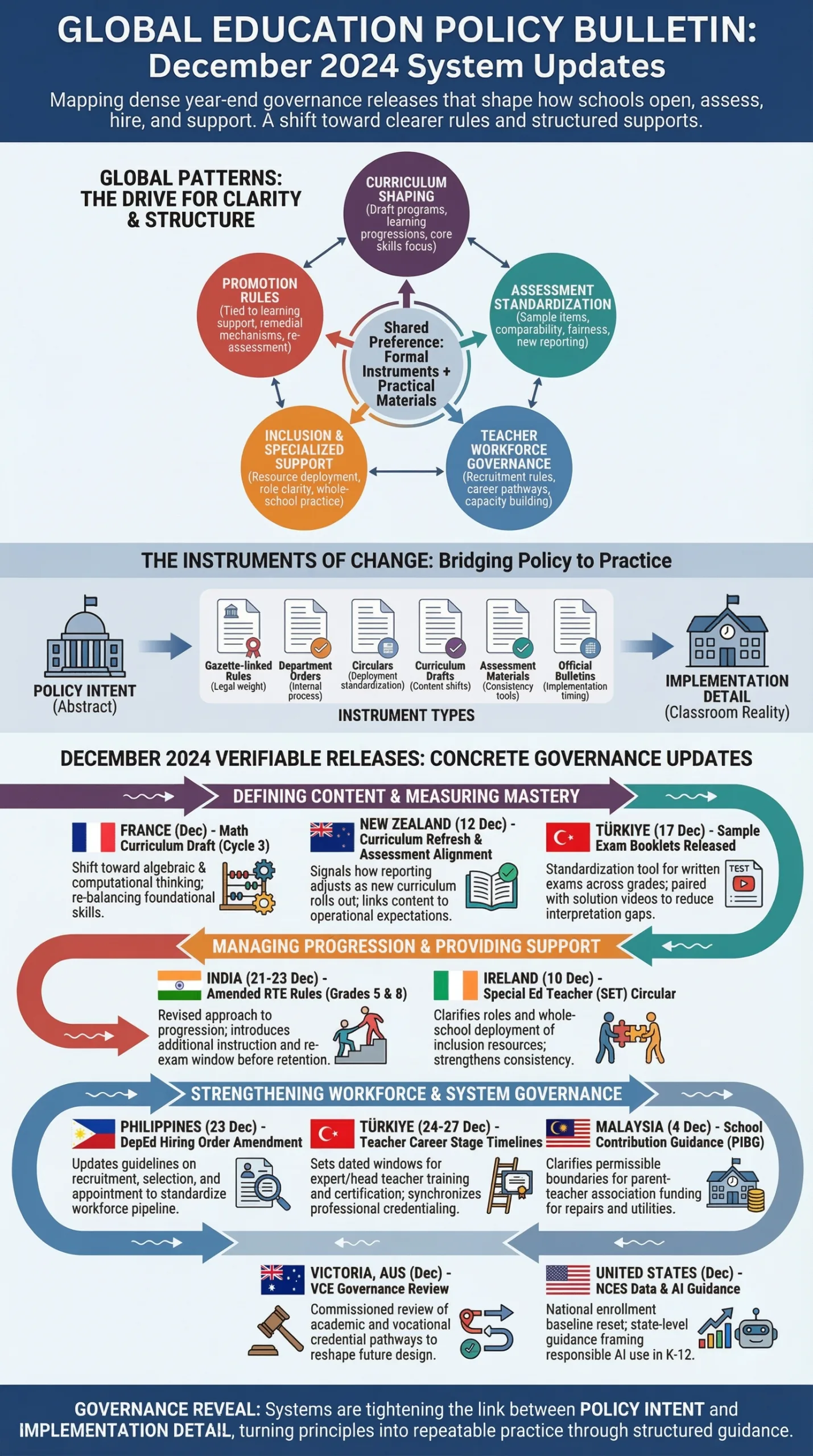
December 2024 was a dense month for education policy, not because one single global event drove it, but because many systems finalize year-end governance and publish official circulars, curriculum updates, and regulatory instruments that shape how schools open, assess learning, hire staff, and support students. This bulletin maps the most verifiable December 2024 releases from public authorities and explains what they changed, what they clarified, and what they signaled for 2025.
Country Updates Published In December 2024
The table below consolidates a set of verifiable December 2024 publications that reflect concrete education governance updates. Each row keeps a single direct source link to preserve traceability without clutter.
| Country / Authority | Dated In December 2024 | What Was Updated | Why It Matters System-Wide |
|---|---|---|---|
| India (Ministry of Education) | 21–23 Dec | Amended RTE Rules describing a revised approach to progression in Grades 5 and 8, including additional instruction and a re-exam window.Source-1 | Re-sets the progression rulebook and defines how learning support and assessment interact. |
| Philippines (Department of Education) | 23 Dec | DepEd Order amendment to guidelines on recruitment, selection, and appointment in the department.Source-2 | Shapes the teacher workforce pipeline and strengthens process consistency in staffing. |
| Türkiye (Ministry of National Education) | 17 Dec | Released sample exam question booklets and solution videos for written exams across grade levels.Source-3 | Supports assessment alignment and reduces variation in how schools interpret exam expectations. |
| Türkiye (Ministry of National Education) | 24–27 Dec | Published dated timelines for teacher career-stage applications and certificate issuance within a broader year-end reforms overview.Source-4 | Standardizes career progression and synchronizes professional credentialing. |
| Ireland (Department of Education and Youth) | 10 Dec | Circular on Special Education Teacher resources, clarifying roles and a whole-school approach for supporting students with special educational needs.Source-5 | Improves inclusion consistency and clarifies resource deployment expectations. |
| New Zealand (Ministry of Education) | 12 Dec | School Leaders Bulletin outlining consultation timing for revised curriculum content and signaling assessment/reporting alignment in 2025.Source-6 | Links curriculum refresh to assessment and operational expectations. |
| France (Ministry of National Education) | Dec | Draft mathematics program for cycle 3, describing progression toward algebraic and computational thinking within the program design.Source-7 | Signals content direction and re-balances foundational skills within learning progressions. |
| Malaysia (Ministry of Education) | 4 Dec | Guidance on collecting PIBG contributions for maintenance, small repairs, lift maintenance, and utilities in schools under the ministry.Source-8 | Clarifies school operational funding boundaries and supports consistent practice. |
| Australia (Victoria State) | Dec | Commissioned a review of the VCE and VCE Vocational Major (credential and pathway governance).Source-9 | Sets the agenda for credential design and how vocational pathways sit alongside academic routes. |
| United States (NCES) | 5 Dec | National enrollment release providing updated K–12 totals and trend framing for planning and analysis.Source-10 | Refreshes the planning baseline used across staffing, facilities, and capacity modeling. |
| United States (NCES) | 10 Dec | Adult skills assessment release tied to international survey reporting on literacy and numeracy (PIAAC).Source-11 | Updates the evidence base for lifelong learning policy and workforce education. |
| United States (Massachusetts) | Dec | K–12 AI guidance context referencing task force recommendations and framing responsible use in schools.Source-12 | Signals how systems are shaping digital learning governance around emerging tools. |
What “System Updates” Meant In December 2024
In this bulletin, a system update is a time-stamped public release that changes or materially clarifies how education works: rules for assessment, promotion, teacher workforce, curriculum, school operating requirements, or the governance structures that steer delivery. December publications often bundle “ready for implementation” items with consultation drafts and “resource releases” that standardize practice.
Where a country did not post a clearly dated December 2024 item on an accessible official page, it is not listed here. That choice protects accuracy, keeps the bulletin evidence-led, and avoids turning education reform into guesswork. Each cited item links to a direct page or file, with a single footnote-style link labeled Source.
Global Patterns Seen In December 2024
Across jurisdictions, December 2024 releases showed a shared preference for clearer rules and more structured supports. Authorities leaned on formal instruments (orders, circulars, gazette notifications) to reduce ambiguity in promotion and hiring, while also publishing practical materials that make assessment and curriculum easier to apply consistently.
- Curriculum shaping through draft programs and public consultation windows, often emphasizing learning progressions and stronger core skills.
- Assessment standardization via official sample items, guidance, or new reporting expectations that strengthen comparability and fairness.
- Promotion rules tied to learning support, with mechanisms like remedial instruction and re-assessment to keep learning outcomes central.
- Teacher workforce governance through updated recruitment, appointment, and career pathway rules that influence system capacity and quality assurance.
- Inclusion and specialized support framed as whole-school practice, backed by resource deployment guidance and role clarity.
Curriculum Content and Learning Progressions
A visible December 2024 trend was the use of program drafts to reset expectations about what is taught and when it is taught. France published a draft mathematics program for cycle 3 (roughly upper primary into early lower secondary) that explicitly describes a gradual shift from arithmetic toward algebraic thinking, and it also frames computational thinking as a capability linked to understanding modern digital topics.Source-13
New Zealand’s December bulletin similarly positioned the curriculum as a living system: it described consultation windows for revised learning area content and signaled how assessment and reporting expectations would adjust as updated curricula roll out across year levels. The emphasis was not only on content, but on system alignment between teaching, assessment, and reporting.Source-14
Assessment Materials and Examination Readiness
Another common December 2024 move was publishing assessment materials that reduce uncertainty before high-traffic testing periods. Türkiye’s Ministry of National Education released example question booklets for written exams across grade levels and paired them with solution videos, explicitly tying the examples to topic distribution tables and intended learning outcomes. This is a standardization tool as much as it is a student resource, because it shapes how teachers design open-ended and short-answer items within the same assessment frame.Source-15
In the United States, December 2024 also brought updates that strengthen measurement. A federal statistics release reported K–12 enrollment totals, adding a fresh reference point for system planning and the interpretation of staffing, funding, and capacity decisions. Even when a release is “data” rather than “law,” it can still function as a system update because it resets the baseline used across the sector.Source-16
Promotion, Progression, and Learning Support Rules
December 2024 also highlighted a policy tension that many systems manage carefully: how to protect student progression while keeping learning outcomes meaningful. India’s Ministry of Education described amended rules under the Right of Children to Free and Compulsory Education framework that introduce a revised approach for Grades 5 and 8 in certain central-government-controlled contexts, including additional instruction and a re-examination opportunity within a defined time window before a student continues in the same grade. The stated logic centers on targeted learning support and equity rather than a purely punitive model.Source-17
Teacher Workforce Rules and Career Pathways
Hiring, appointment, and career structures are among the most consequential system levers, because they shape classroom capacity for years. In the Philippines, a December 2024 Department of Education order amended earlier guidelines on recruitment, selection, and appointment. When a ministry updates these rules, it is not a minor administrative tweak; it affects how candidates enter the system, how appointments are validated, and how workforce standards are applied across regions and roles.Source-18
Türkiye published a year-end overview that included concrete timelines for teacher career stages. It specified an application window for training programs tied to “expert teacher” and “head teacher” titles and noted that certificates would be issued from a stated date. This kind of dated guidance functions as operational governance: it sets a single system clock for eligibility, certification, and the related professional entitlements that follow those titles.Source-19
Inclusion, Support, and Resource Deployment
Inclusive education updates in December 2024 often focused on resource deployment rather than slogans. Ireland published a circular outlining the operation and deployment of Special Education Teacher resources, emphasizing roles, responsibilities, and a whole-school approach to supporting students with special educational needs. This type of circular is a system stabilizer: it reduces variability in how support is organized and strengthens accountability for consistent provision.Source-20
Governance Reviews and Structural Signals
Some December 2024 updates were not direct classroom rules, but signals about system governance. Victoria (Australia) established a review of the VCE and VCE Vocational Major. A review, when formally commissioned, is a governance instrument: it can reshape assessment design, credential pathways, and how the system balances academic and vocational routes over time. December timing matters here, because reviews often set agendas that land in the following academic year.Source-21
Operational Boundaries, Funding, and School Contributions
Operational guidance can also be a meaningful system update, especially where it clarifies what schools may request from families, communities, or affiliated organizations. Malaysia’s Ministry of Education published guidance on collecting PIBG (Parent-Teacher Association) contributions for maintenance, small repairs, lift maintenance, and utilities in schools under the ministry. Even when a document is “guidance,” it shapes school-level practice and strengthens consistency around what is permissible and how contributions are framed.Source-22
December 2024 Releases By Instrument Type
One reason December feels “busy” is that different tools land at once: legal notifications, administrative orders, and implementation materials can all appear within days. Seeing the instrument type helps interpret the real weight of an item in the education system.
- Gazette-linked rule changes that update promotion or student progression frameworks.
- Department orders that redefine recruitment, appointment, and internal workforce processes.
- Circulars that standardize resource deployment for inclusive education.
- Curriculum drafts that shift learning progressions and embed new competencies.
- Assessment materials that improve consistency and reduce interpretation gaps in exams.
- Official bulletins that set consultation windows and clarify operating requirements and implementation timing.
What These Updates Reveal About Education Governance
Seen together, December 2024 updates show that many systems are tightening the link between policy intent and implementation detail. A curriculum draft sets direction, but bulletins and circulars specify timing, responsibilities, and how teaching connects to assessment and reporting. Orders that adjust recruitment rules may look administrative, yet they reshape system quality by determining who enters the profession and how consistently appointments are made.
December releases also show a preference for structured supports rather than vague encouragement. Where progression rules change, the language often pairs them with additional instruction and clearer re-assessment steps. Where inclusion is the focus, guidance tends to define roles and deployment models, turning principles into repeatable practice. Where exams are central, ministries increasingly publish sample items that help create a common understanding of what “good” looks like within a standardized frame.